
iGaming SEO: How a Redesign Can Grow Organic Traffic
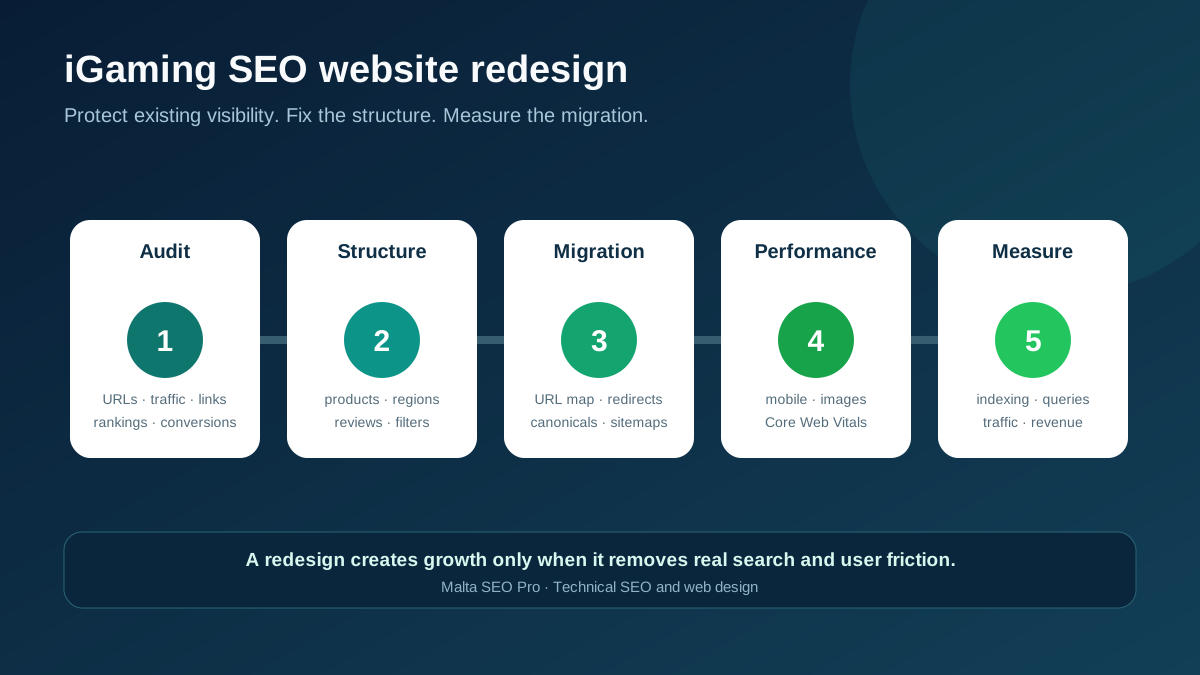
A redesign can improve iGaming SEO when it fixes structural problems rather than only changing colours and components. It can also remove years of organic visibility in a single launch if valuable URLs disappear, internal links break or search engines receive conflicting indexing signals.
Casino, sportsbook and affiliate websites make migrations unusually demanding. They often combine several products, multiple jurisdictions, changing offers, large review libraries and filters that can create thousands of low-value URL combinations. The right redesign turns that complexity into a clearer search and user journey.
Start with outcomes, not appearance
Define what the redesign is expected to improve before selecting a framework or drawing a new homepage. Useful objectives might include:
- Making casino, sportsbook and payment content easier to discover
- Separating country-specific information from global editorial content
- Improving mobile speed on review and comparison templates
- Consolidating overlapping articles that compete for the same queries
- Making licensing, ownership, authorship and safer-gambling information easier to verify
- Connecting organic landing pages to measurable enquiries, registrations or affiliate clicks
Record a baseline from Search Console, analytics and the current crawl. Include organic clicks, impressions, indexed URLs, top landing pages, conversions, Core Web Vitals and the pages attracting external links. Without this baseline, a team cannot distinguish a migration issue from ordinary ranking volatility.
Protect the pages already earning visibility
The existing URL inventory is the redesign's most important working document. Export indexable URLs from the CMS, sitemap, analytics, Search Console and a full crawl. Add each page's traffic, backlinks, canonical target and planned action.
Every old URL should have one clear outcome:
- Keep it when the page still serves its search intent.
- Improve it when the topic is valuable but the content or template is weak.
- Merge it into the closest stronger page when several URLs overlap.
- Remove it only when there is no useful equivalent and no meaningful demand or link equity to preserve.
When a URL must change, redirect it directly to the closest replacement. Avoid redirect chains and blanket redirects to the homepage. A sports betting guide should not resolve to an unrelated casino landing page merely because both sit on the same domain.
Google recommends preparing a URL map, using permanent server-side redirects and keeping redirects in place for as long as possible. Update internal links, canonicals and XML sitemaps to point straight to the new URLs rather than relying on redirects internally.
Build an information architecture around real user choices
A strong iGaming structure reflects how users research products. Someone comparing live casinos has a different task from someone checking whether an operator accepts a particular payment method or is available in a specific country.
Useful top-level groups may include:
- Casino and sportsbook reviews
- Product types such as live casino, poker or crypto betting
- Payment methods
- Country or jurisdiction guides
- Bonuses and promotional terms
- Regulation, licensing and responsible gambling
- Industry news and educational guides
The online casino and sportsbook reviews on iGaming Bible illustrate one practical approach: visitors can filter reviews by product type and region before opening a detailed review. The useful SEO lesson is not the visual treatment; it is the clear relationship between discovery pages, filters and detailed content.
Filters require discipline. A filter should produce an indexable landing page only when it serves distinct demand and contains useful content. Sort orders, empty combinations and near-duplicate filter states should not create unlimited crawlable URLs. Decide which combinations deserve clean static URLs, then control the rest with links, canonicals and crawl rules appropriate to the implementation.
Separate markets without duplicating them
Availability, licensing, bonuses, payment methods and safer-gambling rules vary by jurisdiction. A redesign should make that variation explicit rather than changing a few country names across copied pages.
Use a stable URL model for genuine regional versions. Each page should explain what is different in that market and identify the applicable operator entity or regulator where verified. If equivalent pages exist in different languages or regions, connect them with valid hreflang annotations and self-referencing canonicals.
Do not create a country page simply because a keyword tool shows a location modifier. Thin regional templates can multiply maintenance work while offering little value. Publish a market page when the product, rules, evidence or user journey is genuinely different.
Improve trust as part of the template
Trust elements should not be scattered through marketing copy. Build them into the content model and page templates.
For operator reviews, this can include:
- Named authors with relevant editorial profiles
- Clear publication and update dates
- Verified licence details with regulator links
- Transparent ownership and commercial disclosures
- Sources for factual and regulatory claims
- Visible bonus terms rather than headline-only offers
- Responsible-gambling information and age restrictions
- A correction process and clear editorial policy
Structured data should describe content that visitors can see. It does not turn an unsupported rating or thin review into a trustworthy result. Treat schema as a machine-readable version of the page, not a place to make stronger claims than the visible copy supports.
Make mobile performance a design requirement
Most redesign mock-ups are approved on large desktop screens, while complex navigation, comparison tables, consent tools and promotional components create the real problems on mobile.
Set performance budgets before development. Compress and correctly size hero images, reserve dimensions for banners, limit third-party scripts and avoid loading every review card or game image before it is needed. Test representative templates, not only the homepage.
Core Web Vitals provide useful field metrics: Largest Contentful Paint, Interaction to Next Paint and Cumulative Layout Shift. Passing them does not guarantee rankings, but poor loading, responsiveness or visual stability can damage both discovery and conversion. Measure with real-user data where available and use lab testing to diagnose individual templates.
Launch with a controlled migration checklist
Crawl the staging site before release. It should be accessible to the project team but blocked from search indexing. Compare staging URLs with the migration map and check:
- Every valuable old URL has the intended destination
- Redirects are direct and return the correct permanent status
- Canonicals point to indexable production URLs
- Important pages are not blocked by
robots.txtornoindex - XML sitemaps contain only canonical, indexable URLs
- Navigation and contextual links reach priority pages
- Mobile content matches the information available on desktop
- Structured data validates and matches visible content
- Analytics, consent and conversion events work
- Custom 404 pages return an actual 404 status
After launch, crawl both the old and new URL sets. Submit the new sitemap in Search Console, inspect priority pages and monitor indexing, clicks, conversions and server errors. Expect some fluctuation, but investigate sudden losses by template, directory and query group rather than waiting for the whole site to recover on its own.
A redesign creates opportunity, not automatic growth
A technically safe migration preserves the foundation. Growth comes from using the redesign to remove duplication, improve templates, strengthen regional content and make important pages easier to reach.
The practical order is simple: protect what already works, fix structural weaknesses, launch with measurable controls and improve from real search and conversion data. For operators and publishers planning a migration, our web design service and SEO services for Malta businesses can assess the current site before development begins.
Sources
Ready to Boost Your Online Presence?
Get a free SEO audit for your Malta business and discover opportunities to rank higher on Google.
Get Your Free SEO Audit